Frequently asked. Clearly answered.
Explore PCT’s complete school, course, clinical-experience, tuition, and career-support information in a structure designed for people and search engines.
About Our School
How long has Phlebotomy Career Training (PCT) operated?
PCT opened its doors in 2009 and has been training students across the country and the world. Started by Nancy Kimmel, her vision was to offer affordable education, with no cap on how much knowledge students can learn. Her goal of the school was to provide a higher quality of education that was comparable with community colleges and universities. Having taught Math and Engineering at Henry Ford College, Mechanical Engineering at Lawrence Technological University as well as at Oakland University, Ms. Kimmel understood teaching at a very high level. She went to nursing school and then opened Phlebotomy Career Training. Later in 2014 she completed her MSN-FNP-BC through Walden University and proceeded to go to medical School. She went on to get her Pharmacy Technician License through the state of Michigan so that she could better develop the online Pharmacy Technician Program. For the past sixteen years her goal has facilitated Phlebotomy Career Training’s students to obtain employment at hospitals and clinics nationwide. The curriculum is unique in presentation to help students retain difficult concepts. The Current Learning Management system is now on Moodle.
Phlebotomy Career Training is expanding and has added a new name to their brand which is PCT Institute of Healthcare
Is PCT Licensed?
PCT is a licensed post secondary proprietary school in the state of Michigan and has been issued a school license number, 8604000933. Each year Phlebotomy Career Training must renew their proprietary school license with the state of Michigan.
Is PCT an accredited institution?
PCT is in the process of seeking accreditation through ABHES for programmatic accreditation as well as school accreditation through the NCCA. Multiple national accredited organizations recognize Phlebotomy Career Training’s programs and allow PCT’s students to test at the national level. Student may test through following accredited organizations, The National Center for Competency Testing (NCCT). NCCT is an independent accrediting organization serving technical schools throughout the U.S. for nearly 30 years. It’s the same kind of accreditation process colleges and universities must undergo. Phlebotomy Career Training’s transcript provide clock hours which can be transferred into credit hours at universities and colleges as well as technical schools.
In addition, the following organizations also certify PCT’s courses: Phlebotomy Career Training pays for the students national exams which are included in most of the courses.
- National Healthcareer Association (NHA)
- American Medical Certification Association (AMCA)
- National Association for Phlebotomy Technician Professionals (NAPTP)
- NCCT (National Center For Competency Testing)
- NIVA National IV Association
- National Telemetry Association
- PTCB (Pharmacy Technician Certification Board) Phlebotomy Career Training can be found on the PTCB’s website and the Pharmacy Licensing Exam is paid for by Phlebotomy Career Training for all students enrolled in the Pharmacy Technician Program.
- American Medical Technology (for Phlebotomy only)
What are the prerequisites I need to fulfill before registering at PCT?
Prerequisites are:
- High school diploma or GED, or be currently or planning to take your GED.
- Students may also register if they have completed High School in another country.
- Students must be 18 years or older
- There are typically no prerequisites for most of our classes other than Medical Laboratory Technician which requires phlebotomy experience, IV technician, which also requires phlebotomy experience and Patient Care Technician which requires students to either have CNA experience or home health aide experience.
- Minimum 6th-grade education required for the Certified Nursing Assistant Program
- Student should have no criminal background as this could hinder their job placement. The infarctions vary and students who have a blemish on their background should always check with their states laws governing healthcare related employment.
Completion of a Michigan State Criminal History Background Check is required prior to entry into both programs. (Cost of the criminal background check is $20.)
Will My Certificate Expire?
No! Students who receive a certificate of completion from Phlebotomy Career Training or PCT Institute of Healthcare, can feel confident in that their certificate will never expire.
Can I take the NHA Exam With My Certifiate?
Yes! Students who have graduated from the following programs are eligible to take the following NHA exams: Clinical Medical Assistant, Medical Administrative Assistant, Patient Care Technician, EKG/ECG Technician, Medical Billing and Coder, Phlebotomy Technician
Courses, Certificates & Clinical Experience
How soon can I complete the initial course?
Phlebotomy Career Training’s online courses start immediately upon students registering. Upon registration, the student will get a welcome email from their instructor, introducing them to their class and providing guidance. If a student registers outside of business hours which are 9-5pm EST, they can expect an email from their instructor the next morning. Completion of each differs based upon a students prior experience and how much time they have to dedicate to their studies. This is why all online students are provided six months to complete their course as well as apply for their national exam.
Our phlebotomy course can be completed in as little as four weeks. To accommodate a wide array of schedules, however, we offer less intensive phlebotomy course schedules, as well. Many of Phlebotomy Career Training’s programs are typically three months, with an additional three months allotted for clinical practice. It is important for students to read the requirements associated with all courses as the clinical portion can sometimes take a bit of time to complete. This is based on the facilities accommodation’s as well as the students availability.
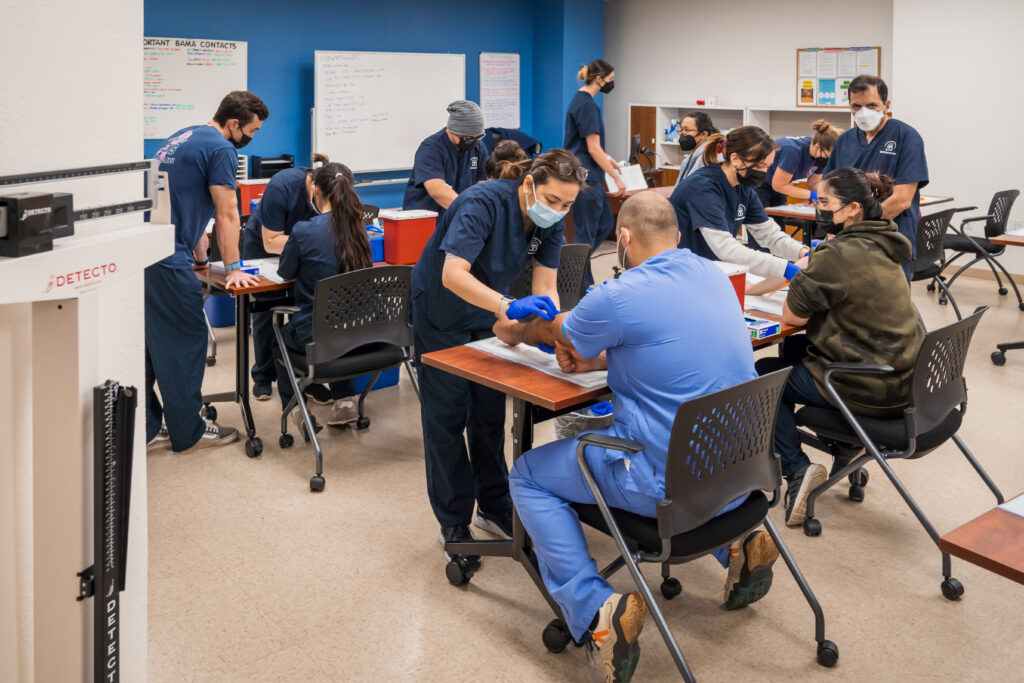
In person students follow a much more rigid schedule than our online students. In person students come to class from 8:30-12:30 twice a week for 7 weeks and then begin their clinical practicum on week 8.
Do Phlebotomy Career Training’s Certifications Expire
Once you graduate and receive your certification from Phlebotomy Career Training, it is good for life. Your certification never expires.
Externships and Internships
Phlebotomy Career Training has hundreds of hospitals and clinics nationally where students may take advantage of hands on training. Our contracts however, do not guarantee that each student will have placement. It is up to the student to find their own clinical site. Phlebotomy Career Training does not place students. Our list of clinical sites will be presented to enrolled students applicable for their state and region. It is important for students to begin their externship/internship search prior to enrolling to facilitate a smooth experience.
Both the CCMA and the AMA require 204 hours of clinical experience. This can be found on each students rotation clinical requirement sheet. If students have experience in any of the required curriculum of any course which requires a clinical, they are encouraged to send in their documentation. Notarized resumes are also accepted. Experience must be current or a the maximum 24 months.
Should a student take advantage of one of Phlebotomy Career Training’s contracted sites, they will be provided a list of necessary steps and paperwork that must be turned into to our support and administration staff.
The clinical experience is a very integral part of Phlebotomy Career Training’s many programs. It is a rewarding experience for the students and usually results in placement in the facility afterwards. Students must be prepared to turn in the following should they land a externship or internship with one of Phlebotomy Career Training’s contracted healthcare facilities: to name a few, would be the flu shot typically required during flu season, MMR and Varicella vaccines, a comprehensive nationwide background check, amongst other important paperwork.
Clinical paperwork can be found in the course attachments within the student course. This paperwork must be filled out by a licensed preceptor such as a RMA, NP, PA or Physician.
Prior experience is counted toward clinical hours. All students are encouraged to submit documentation of all prior healthcare experience to be reviewed by our educational coordinators.
Enrolled students can reach out to their coordinator at [email protected] or [email protected] to get started on their externships or internships. It is important for all students to have completed their final exam successfully to be eligible for access to Phlebotomy Career Training’s list of clinical sites.
Other than phlebotomy, what other courses can I take at PCT?
We offer the courses you need to enter fields such as Telemetry Technician (where students learn to read Electrocardiograms), Electrocardiogram Technician (where students will learn to place Electrocardiogram leads on patients in the hospital or out patient surgery.
New courses now include: Medical Laboratory Technician, Administrative Medical Assistant, Mental Health Technician, and we are currently waiting on approval for our HIPAA Policy Supervisor Course.
We also offer Clinical Medical Assistant, IV Technician, Dialysis Technician, Medical Billing and Coding, Dental Assistant and our unique course first started by Phlebotomy Career Training and designed by Nancy Kimmel,
the Cardio- Phlebotomy course.
Students can also choose from combination courses such as Clinical Medical Assistant + Phlebotomy Technician, or Clinical Medical Assistant Tier II (which includes the CCMA course, EKG/ECG program and Phlebotomy Technician)
Medical Assistant Tier III which includes, the CCMA (Clinical Medical Assistant, Phlebotomy Technician, EKG/ECG Technician and IV Technician)
Medical Assistant Tier IV, which includes, the CCMA (Clinical Medical Assistant, Phlebotomy Technician, IV Technician, EKG/ECG Technician, Medical Billing and Coding as well as Pharmacy Technician.
Pharmacy Technician, and many others. Phlebotomy Career Training is constantly adding more courses to their robust list of courses. Current Phlebotomy Career Training No other educational institution can do more to prepare you for a career in medicine.
Tuition, Career Support & Outcomes
What if I can’t afford a course I want to take?
We recommend prospective phlebotomy students look into Michigan Works! and Michigan Rehabilitation inquire about financial support and other options. Phlebotomy Career Training also offers Afterpay and Klarna. Please note that these are separate organizations and Phlebotomy Career Training does not control or have any influence as to whether or not a student is eligible. Student will apply directly through the Afterpay or Klarna websites. Phlebotomy Career Training, accepts state funded aid as well as scholarship money from all states in the union. Phlebotomy Career Training accepts state aid from the Indian Nations. We encourage students to reach out to their state funded education programs to see if they qualify. In the state of Michigan, Phlebotomy Career Training accepts funding through Michigan Rehabilitation, Michigan Works, and many more.
Does PCT offer career counseling and support?
Absolutely! It’s always a good idea to speak with someone about your goals and scheduling needs. Visit this page to learn how to contact us. Our staff is in the office from 9am-5pm M-F EST to take calls from current and prospective students. They are trained and ready to answer any question that you may have. Our instructors are available for Zoom meetings or Google meets with students Tuesdays and Thursday from 1 to 3 pm. Current students may schedule their appointments via the link provided in their welcome email. Student may call, 1-888-410-6416 for assistance.
How Much Do Phlebotomists Make?
Phlebotomy graduates just coming out of school can make up to $20 to $21.88 per hour according to the Bureau of Labor and Statistics. However, with six months of experience their pay will increase. Also, working as a traveling phlebotomist. Added: Student can take advantage of our resume templates which our teachers have worked diligently to create. There are also videos for the students to watch on the do’s and don’ts for interviewing for hospital, healthcare and other medical positions.
How Much Do Traveling Phlebotomists Make per hour
Traveling phlebotomists pay can be $33 to $45+ per-hour according to Zip Recruiter.
How Much Do Medical Assistants Make?
Medical assistants in the United States earn a national median salary of $44,200 per year, which breaks down to approximately $21.25 per hour, according to the latest U.S. Bureau of Labor Statistics (BLS) reports. This rate can go up considerably with experience. A great side job for Clinical Medical Assistants is to work for Health Screening Organizations. Medical assistants (MAs) working with traveling health screening organizations earn an average of $18 to $28 per hour, which equates to roughly $800 to $1,400 per week depending on the region, contract duration, and specific certifications according to Glass Door.
Are PCT graduates getting jobs in the field?
We’re happy to have 95% of our graduates working in the field. And working well, too! They represent PCT so well that some of the region’s largest healthcare providers specifically seek PCT students for their teams. Phlebotomy Career Training has a job board for its graduates which not only lists job opportunities from employers who have directly contacted Phlebotomy Career Training and asked us to post their job, but from other national organizations.
Student can take advantage of our resume templates which our teachers have worked diligently to create. There are also videos for the students to watch on the do’s and don’ts for interviewing for hospital, healthcare and other medical positions.
Campus & More Questions
What dining options are near the school?
In case you arrive early or want to grab a bite when you leave, there are several options within a single mile of the school. Those include fast food places such as McDonald’s, KFC, and Burger King. There are also more formal — but still casual — places such as Dearborn Cafe, Al Ameer, and Ram’s Horn.
Have any other questions?
If you have any other questions, please contact us! We’ll be happy to help.
Let’s talk through your next step.
Admissions can help you compare program formats, schedules, prerequisites, and payment options.