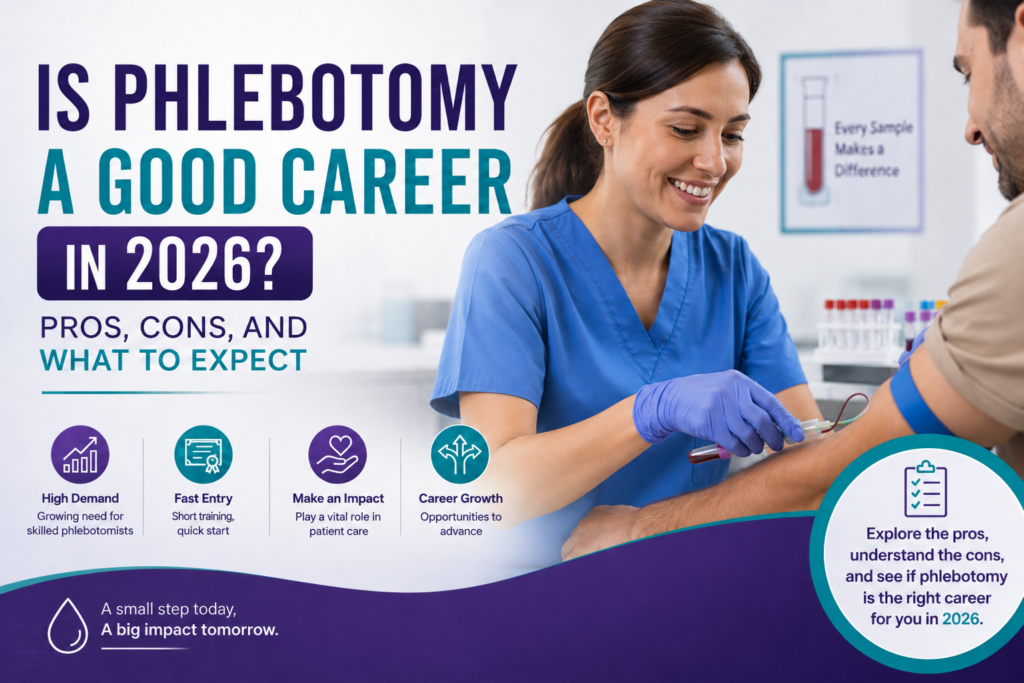
Phlebotomy is no longer a technical role that is played out behind the scenes. Is phlebotomy a good career option for you? What is phlebotomy? On the face of it, it is a primary healthcare profession that involves patient experience, diagnostic accuracy, and risk mitigation.
As we set our eyes on this year and toward 2027, the phlebotomy career outlook is expanding, evidenced by the demand for trainers, educators, and healthcare professionals. The scope for this procedure is growing, and this is where competent, confident blood collection professionals come into play.
Is Phlebotomy in Demand?
The answer is ‘yes’. Here are the factors that influence the steady growth of phlebotomists:
- Expanding healthcare industry: The rise in aging population and advances in medical tech have increased the need for diagnostic testing, which requires skilled phlebotomists.
- Scheduled testing: Most medical tests require blood sample collection and investigation, and you need professionals for this task.
- Ambulatory and outpatient services: The rise in urgent care centers, specialized testing facilities, and outpatient clinics supports phlebotomist careers outside the usual hospital settings.
- Phlebotomist job outlook 2026: Phlebotomy leads to diverse medical career opportunities, thus making it popular among job aspirants.
Phlebotomy Career Growth
Is phlebotomy a good career choice in 2026? According to data from the Bureau of Labor Statistics, phlebotomist jobs are estimated to grow faster than average through the next decade. The demand will vary based on healthcare setting and region. If you’re considering a career in this field, it is a viable choice with good growth prospects.
Pros and Cons of Being a Phlebotomist
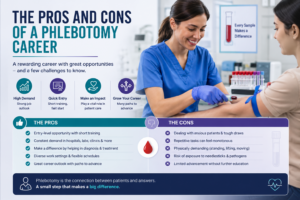
Is becoming a phlebotomist worth it? Other than being an in-demand fast-track career choice, this field also carries discomfort, physical risks, and on-the-job stress. Let’s check some of these in further detail:
- Entry-level opportunity: Phlebotomy usually requires a brief training/certification; so it is accessible for entry-level professionals in the healthcare segment.
- Constant demand: Phlebotomists are in constant demand in clinics, labs, hospitals, blood donation centers, and healthcare facilities.
- Assisting people: Phlebotomist professionals are central to the healthcare industry as they help in collecting blood samples for diagnosis and treatment.
- Diverse work setting: Those looking for phlebotomy career growth can work in outpatient clinics, hospitals, blood banks, research labs, and home-based (mobile) health services. The growth of mobile phlebotomy has cemented patient confidence for navigating health concerns. As a mobile phlebotomist, you can ensure frequent touch points and help patients who want to avoid waiting rooms.
- Flexibility: You can work in shifts, on a part-time basis, and even travel to other locations, thus achieving work-life balance.
- Job outlook: As a job, phlebotomy often leads to other careers in the healthcare segment like physician assistant programs, nursing, or medical lab technology.
Ready to build a rewarding career in healthcare? Start your Clinical Medical Assistant Training today and gain the practical skills needed to support both patient care and essential administrative tasks. Take the next step toward becoming a confident, career-ready medical assistant!
While the phlebotomy career outlook is a rewarding one, it is important to be aware of the flip side. Here are some of the downsides you should be mindful of:
- Challenges in patient interaction: Patients with needle phobia might be difficult to deal with, especially if they are reluctant to cooperate or have tough veins.
- Repetitive job: Phlebotomy careers can be repetitive and hence monotonous.
- Physically demanding: Phlebotomists spend much time standing, carrying equipment, or moving patients, which can be exhausting.
- Threat to exposure: You can be exposed to needlestick injuries and bloodborne pathogens. So make sure you follow the standard safety protocols.
- Emotional aspects: Handling anxious or sick patients can take a toll mentally.
- Restricted growth without education: Career advancement opportunities can be limited without the relevant certifications or education.
Is becoming a phlebotomist worth it?
Phlebotomy can be a rewarding career choice for everyone who enjoys patient interaction and prefers a diagnostic role that guarantees a faster entry in the medical profession. Online and in-person programs are widely available, making it easier to pursue Phlebotomy Technician Certification and develop the skills needed for a successful career in healthcare. When becoming a phlebotomy professional or expert might be your career option:
- You want to make a quick entry in the healthcare field: Those wondering ‘is phlebotomy a good career choice’, the good news is that the training takes just a few months, which lets you start working faster compared to other healthcare roles.
- You enjoy patient interaction hands-on: If you are keen to work directly with patients and contribute to their care, here is a daily opportunity waiting.
- You want a stable job: As the need for skilled professionals is steadily rising, these roles are excellent in many areas. You have the certification and skill necessary for the job.
- You want to branch into similar healthcare roles: Many aspirants start as phlebotomists to gather experience first before progressing to medical technology, nursing, or other clinical professions.
- You want a career without extensive training: If returning to school for the long term is not an alternative, this is a meaningful healthcare role that demands less investment in education and training.
A Stressful Job/Dying Career?
No, phlebotomy is not dying, but yes, it can be a stressful job. No matter what, phlebotomy remains an essential role within healthcare. Let’s explore the reasons why:
- Modern medicine relies heavily on blood sample testing and diagnosis.
- There is a steady demand due to the rise in the aging population and growing healthcare needs.
The phlebotomy career outlook goes beyond hospitals in diverse settings like labs, home healthcare, blood banks, and outpatient clinics. It will evolve with technology (some blood tests might use smaller samples or become less invasive), but it will not replace the job of the trained professionals anytime soon.
Improved devices and automation might aid the prospect of phlebotomy career growth as the human skills for effectively and safely drawing blood are not likely to be fully phased out, especially in cases where the process gets challenging or complicated.
Ready to take the next step toward a rewarding healthcare career? Enroll in an Online Medical Assistant Course and gain the flexibility to learn at your own pace while building essential clinical and administrative skills. Start your training today and move closer to your career goals!
Competitive Nature of the Phlebotomy Field and 2026 Career Outlook
Phlebotomy can be somewhat stressful due to the physical demands, patient anxiety, and pace of the job, but it is manageable and rewarding as well. The steady demand can be attributed to the central role blood testing plays in the healthcare industry. Is phlebotomy a good career? Yes. With the right work setting, training, and experience, you can successfully overcome the stress this job involves.
The employment of phlebotomists is estimated to expand by about 17% from 2022 until 2032, faster than average for other occupations. The factors contributing to this demand include expansion in healthcare, outpatient centers, blood screening tests, preventative care involving early diagnosis, and home health services.
Phlebotomists find jobs in diagnostic labs, hospitals, blood donation centers, physician offices and clinics, and home healthcare agencies. The phlebotomist job outlook 2026 promises fair pay, though the median varies in terms of experience and location. The salary is typically moderate.
Looking to start a healthcare career without putting your current commitments on hold? Discover Why an Online Medical Assistant Course Offers More Flexibility Than Ever and learn how flexible online training can help you develop essential medical assisting skills while fitting education into your schedule.
Is Phlebotomy Worth it Without a Degree?
Absolutely! You don’t need a traditional college degree. Here’s why:
- Most programs take a few weeks to a few months to complete. A college degree is not compulsory. Certification is preferred or required, but it is more accessible than a degree program.
- Affordable costs: Training programs are comparatively inexpensive than degree courses, thus reducing upfront educational costs.
- Career mobility and flexibility: While a degree can increase your advancement opportunities, employers usually prefer certified professionals without degrees. This improves your chances to further your career in the field of healthcare. The jobs often come with flexi schedules.
People also Ask
Early-career phlebotomists need to beware of common concerns like inadequate ID verification for patients, inadequate post-venipuncture care, inappropriate order of tube draw, and hesitation/lack of confidence with equipment. These pain points can be handled with simulation by incorporating these into practice modules and competency signoffs. Simulation-oriented programs report less remediation rates and quicker progression towards clinical autonomy.
For phlebotomy to be a reliable career choice, it is important to emphasize patient experience and trust. According to a study conducted by the Agency for Healthcare Research and Quality (AHRQ) in 2023, the patient trust experienced in phlebotomy encounters influenced their overall satisfaction quotient, especially in outpatient situations. With successfully simulated interaction scenarios, the aspiring phlebotomist can better address linguistically diverse, pediatric, or anxious groups. The focus should not be limited to merely enhancing your technical skills but also working on your manners and confidence.
Want to learn from experienced healthcare educators and expand your professional skills? Check out Big News from PCT Institute of Healthcare — Professor Kimmel is Now a Udemy Instructor! to discover how this new learning opportunity can help you gain valuable knowledge and take the next step in your healthcare career.
Growth of Phlebotomist Careers in 2026
The phlebotomist today does a lot more than merely withdraw blood. Here are some add-on roles they are expected to demonstrate:
- Comply with the revised Clinical and Laboratory Standards Institute (CLSI) venipuncture standards of 2023.
- Recognize complications (such as hematomas and syncope) and perform patient assessments.
- Explore health literacy divides and language barriers.
- Strictly abide by infection control protocols (hand hygiene between draws, glove changes, etc.).
- Function near bedside testing equipment (point-of-care testing or POCT).
- Track specimens through radio frequency identification (RFID) or barcoding.
- Simulate PPE compliances, barcode scans, and documentation workflows to make students practice-ready more than process-ready.
- Operate specimen tracking tools and electronic health record (EHR) systems.
In this evolving scenario, procedural compliance is the minimum parameter. Adaptability, emotional intelligence, and situational competence are the essential skills which should be an integral part of training programs for a favorable phlebotomy career outlook. Expanding your skill set through programs such as an EKG Technician course online can also provide valuable knowledge and broaden your opportunities in the healthcare field.
What Kind of Environment do You Want to Create?
Considering the positive phlebotomist job outlook 2026, an aspirant longs for a supportive and uplifting workplace. Ask yourself this: am I creating a harmonious ambience or making it chaotic for the patient? An honest answer to this question is important for your personal and professional growth. Every patient is unique and this is precisely where the catch lies. Are you someone who handles your patients with difficulty or grace? Every day brings an opportunity to mingle with patients from all walks of life. A career in phlebotomy is a long road flung with both pleasant and not-so-pleasant interactions.
Staying focused with a clear head and delivering a world-class experience can go a long way up the career curve. Remember, each tough patient is a learning opportunity, not a problem. In a similar way, a tough boss can be your opportunity to stay focused on your work responsibilities and demonstrate your performance and work ethic. Play along, be a problem solver, a stress buster. In a high-stress environment like this, help your seniors, step up! Take initiative, troubleshoot. This will not only make life easy for your team but also project yourself as a valuable asset. After all, team players are last considered when time comes to cut staff.
Take in that extra work, give your bit. Job descriptions capture a part of the overall responsibilities. Your phlebotomy career growth involves much more than drawing blood. It involves cleaning your workstation, keeping the trays stocked, organizing the medical kits and supplies in advance, and taking on tasks which others might avoid. By volunteering for these small tasks, you can strengthen your opportunity to excel and prepare for the next step in your career. Quality phlebotomycareertraining can also help you build the practical skills, confidence, and professional mindset needed to take on greater responsibilities and advance in the field.
Students aspiring for phlebotomist roles in 2026, there’s good news! Today’s career training programs understand the challenges of adult life. You might be struggling to balance your work and personal requirements, and this is precisely why several flexible programs are on offer designed around your schedule. Whether you are looking for online courses you can take at your own pace or attend them physically with hands-on guidance, there are multiple options for you to explore. Whether you are a day scholar or student, you have numerous flexible courses at your fingertips that can help you navigate your career choices easily.
Once you are all set to become a certified phlebotomist, this is a place for steady growth. An experienced professional may move into specialized or leadership positions. Some probable career opportunities and roles involve lab technicians, lead phlebotomists, healthcare supervisors, and medical laboratory specialists. These roles can pay anywhere between $47,000 and $55,000 or more annually.
For those contemplating ‘is phlebotomy a good career’, the answer is a definite ‘yes’. No matter whether you are looking for a stable career opportunity, a ladder to other healthcare jobs, or an opportunity to create a positive impact on patient lives every day, here is a satisfactory and rewarding career option for you. You can build a successful career in the field with proper certification, commitment, and professionalism.
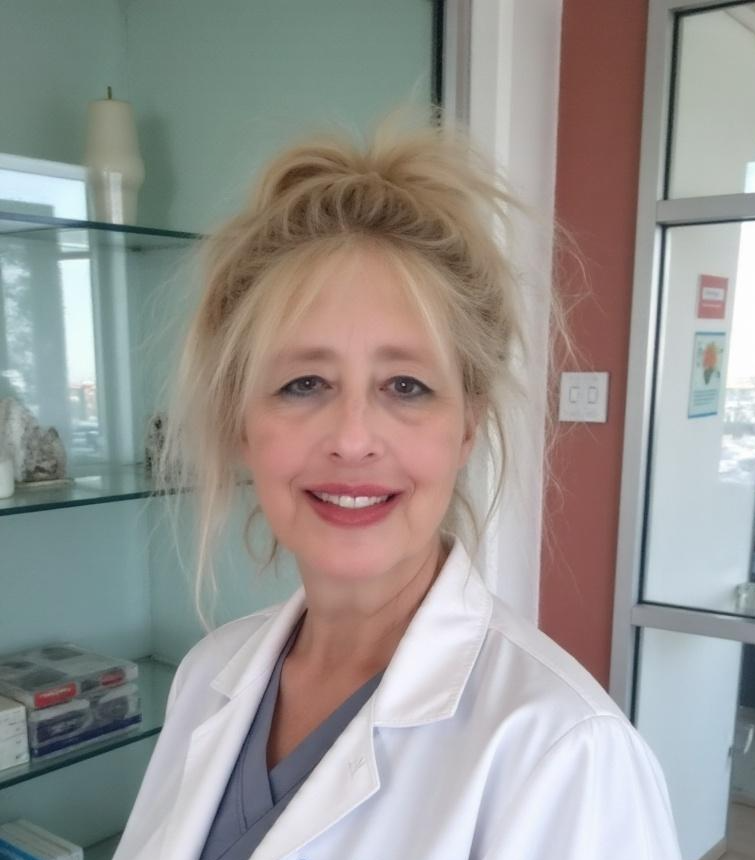
Nancy L. Kimmel obtained her PhD in Environmental Engineering in 2002, then went on to teach Physics and Mechanical Engineering at Lawrence Technological University, Henry Ford College and Oakland University. She obtained her Associate in Nursing from Henry Ford College and then went on to earn her Master Degree as a Family Nurse Practitioner and became Board Certified working as a licensed FNP in the State of Michigan. She then went on to Medical School where she is now in her 3rd year, and is also in the process of obtaining her Doctorate in Nursing Practice through Chamberlin University. She has authored the NET Study Guide, as well a several books on subjects of Math, ECG/EKG and Phlebotomy. She holds a patent on an Air Filter through the U.S. Patent Office.
313-826-2381