
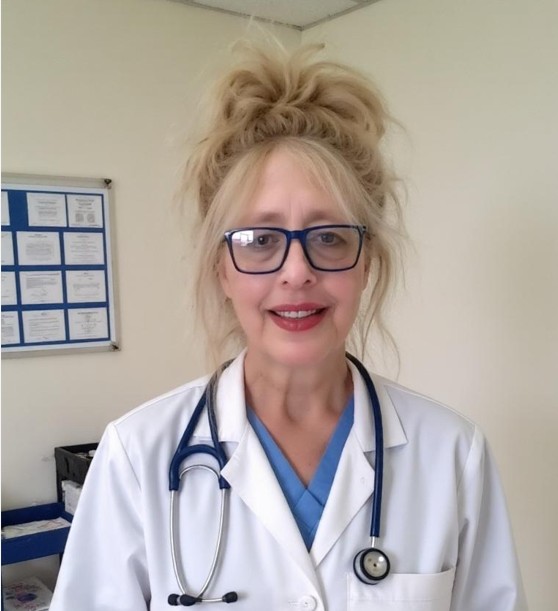
Nancy L. Kimmel, PhD, MSN-FNP-BC
Founder and Director, Phlebotomy Career Training Institute of Healthcare
Who She Is
Dr. Nancy Kimmel is a board-certified Family Nurse Practitioner, a clinician, an engineer, a lifelong student, and above all an educator. For more than twenty years she has taught and developed curriculum in healthcare and in the sciences, and for most of that time she has also been at the bedside herself. Those two things have never been separate for her. Everything she teaches, she has done.
She founded Phlebotomy Career Training on a simple principle: education and training for everyone, so that anyone who wants to become a medical healthcare professional can become one. She kept meeting people who wanted to work in healthcare, who had every quality the field needs, and who could not find a way in. They were working full time. They had families. They could not disappear into a four-year program or absorb tuition that would follow them for a decade. The talent was there. The door was not. She built the door.
Background and Education
Dr. Kimmel’s education has taken an unusual path. She holds a PhD in Environmental Engineering, a discipline that taught her systems thinking, quantitative rigor, and how to take a complicated problem apart into pieces that can actually be solved. She earned a Bachelor of Science, then an Associate in Applied Science in Nursing, and later a Master of Science in Nursing with a Family Nurse Practitioner focus, graduating with a 3.89 grade point average. Her graduate coursework included Advanced Pathophysiology, Advanced Pharmacology, Advanced Health Assessment, Evidence-Based Practice, Primary Care of Women, Advanced Practice Care of Adults, Policy and Advocacy for Population Health, and Interprofessional Organizational and Systems Leadership.
She became board certified through the American Nurses Credentialing Center as a Family Nurse Practitioner and has practiced under that credential ever since. She currently holds certification in Advanced Cardiac Life Support, Pediatric Advanced Life Support, and Basic Life Support for Healthcare Providers, and she is a Certified Hazardous Materials Manager. She is affiliated with the American Nurses Credentialing Center, the Emergency Nurses Association, and the Michigan Nurses Association.
She is also still learning. Dr. Kimmel is a third-year medical student at Xavier University School of Medicine in Aruba, working through a systems-based medical curriculum in which she has earned high distinction in advanced systems modules including the respiratory, gastrointestinal, musculoskeletal, and reproductive systems, and distinction across core medical sciences including physiology, immunology, pharmacology, microanatomy, endocrinology, the hemic and immune system, cardiovascular medicine, neurology and the neurosciences, and renal medicine. She is simultaneously completing her Doctor of Nursing Practice. She asks a great deal of her students, and it matters to her that they can see her still sitting on the other side of the desk, still being asked a great deal herself.
Her clinical foundation was built in acute hospital care in Metro Detroit. She cared for post-operative cardiac and vascular patients in a Heart and Vascular Center and post-procedural unit, monitoring high-acuity patients where there was very little margin for error. She served as lead nurse developing team coordination and educational protocols to prevent post-operative surgical site infections after cardiac procedures, facilitated departmental education in telemetry monitoring and cardiac post-operative care, and served as interim charge nurse managing unit workflow and staff assignments. She later specialized in psychiatric nursing, caring for patients with complex psychosocial and behavioral health needs and working alongside psychiatrists, social workers, and therapists to build comprehensive care plans. Since 2009 she has practiced in a Michigan diagnostic setting, where she joined as a nursing education specialist training staff and improving clinical competencies before moving into direct patient care as a Family Nurse Practitioner.
She has also taught at the university level as an adjunct professor of mechanical engineering, mathematics, and physics. Teaching a student to work through a differential equation and teaching a career changer to find a difficult vein are less different than they sound. Both require breaking a hard skill into pieces a beginner can hold, then rebuilding it until it becomes second nature.
Why She Does This
Dr. Kimmel has spent her career watching two things happen at once. On one side, hospitals and clinics that cannot find enough trained frontline staff. On the other, people who would be excellent at that work and have no realistic path into it.
What she wants, more than anything else the school does, is for her students to succeed. Not to enroll. Not to complete a module. To succeed, meaning they finish, they certify, they get hired, and they walk into a clinical setting on day one knowing what they are doing. That is the only outcome she counts.
It is also why she teaches the way she does. She treats every student as an individual learner with an individual learning style, because that is what they are. Some need to watch a procedure fifteen times before they attempt it. Some need to talk it through. Some need to fail at it privately before they will try it in front of anyone. A good program makes room for all of that without lowering the standard, because the standard is not negotiable. A patient does not care how you learned. A patient cares that you know.
She has never believed that frontline healthcare workers are support staff at the margins of medicine. They are the people the patient actually sees. They draw the sample that determines a diagnosis. They notice when something is wrong. Training them well, in her view, is not a business decision. It is a responsibility.
How the School Began
Phlebotomy Career Training started in Garden City, Michigan. It was small, it was hands-on, and it was built around a single idea: teach the skill properly, prepare students for the national certification exam, and get them working. Dr. Kimmel taught the classes herself. She wrote the curriculum herself. When students needed to see a technique again, she recorded it.
That recording habit turned into something larger than she expected. Over the years she has recorded and edited more than 1,000 hours of instructional medical video, so that a student who missed something, or who needed a fourth pass at a procedure, never had to wait for the next class to get it. For working adults, that access is very often the difference between finishing a program and giving up on it.
Word spread, enrollment grew, and the programs multiplied as students kept asking what else they could learn. The school outgrew Garden City and moved to its current home in Dearborn, where it operates today as Phlebotomy Career Training Institute of Healthcare, a Michigan licensed school offering programs both in person and online. Since 2009 the school has graduated students from its Dearborn campus and from across the United States.
Mission and Vision
The mission is education and training for everyone, so that any person who wants to become a medical healthcare professional has a real path to becoming one. Not a select few. Not only those with the money, the free time, or the family background that makes traditional schooling possible. Everyone who is willing to do the work.
In practice that means preparing capable, confident, certification-ready professionals, and making that preparation reachable for the working adults who need it most: flexible scheduling, transparent pricing, financing without credit checks or interest, and national certification examinations included in tuition rather than billed as a surprise at the end. It means instruction from board-certified medical professionals who have worked in the settings they are teaching about.
Keeping tuition affordable is central to that mission, and it has never meant compromising on quality. Those two things are often treated as a trade-off in this industry, and Dr. Kimmel rejects the premise. Affordable does not mean fewer hours of instruction, thinner curriculum, or instructors who have never practiced. It means running a school efficiently, cutting the costs that do not touch the classroom, and refusing to price students out of a career they are fully capable of having. A graduate of an affordable program still has to draw blood correctly on a real patient. The standard does not move.
The vision reaches well beyond Michigan. A student in a rural county with no training program within two hours should have the same access to quality instruction as a student living ten minutes from a teaching hospital. Online delivery, paired with hands-on skills training and clinical competency validation, is how that gap closes. Dr. Kimmel intends to keep widening that reach until geography stops deciding who gets to enter a healthcare career.
The Programs
Phlebotomy Career Training Institute of Healthcare offers programs online and in person, with national certification examinations included in tuition:
- Phlebotomy Technician
- Medical Assistant and Administrative Medical Assistant
- Cardio-Phlebotomy Technician
- EKG and Electrocardiogram Technician
- Telemetry Technician
- IV Technician
- Patient Care Technician
- Pharmacy Technician
- Medical Coding and Billing
- Dialysis Technician
- Dental Assistant
- Medical Laboratory Technician
- Mental Health Technician
- American Heart Association Basic Life Support Provider Certification
The programs are supported by national certifying bodies including the National Healthcareer Association, the National Center for Competency Testing, the American Medical Certification Association, the National Association of Phlebotomy Technician Professionals, the Pharmacy Technician Certification Board, the National Telemetry Association, American Medical Technologists, and the National I.V. Association.
Dr. Kimmel developed the curriculum behind these programs personally, writing the instructional sequences, assessments, competency checklists, and skills validations that students work through. That is unusual for a school of this size, and it is deliberate. It means the programs are consistent with one another, current with practice, and written by someone who performs these procedures rather than someone who has only read about them.
Beyond the Classroom
Dr. Kimmel is the author of a preparation text for phlebotomy and nursing entrance examinations, written for students approaching healthcare education without the advantages of a traditional academic background. She holds a patent for an air filtration design, work that sits at the intersection of her engineering doctorate and her clinical concern with environmental health. She has also built certification standards, examinations, and continuing education pathways for allied health professionals nationally, because she believes this workforce deserves credentials that are rigorous and respected rather than dead-end certificates.
What Students Can Expect
A student considering a program here is getting an instructor who has monitored post-surgical cardiac patients through the night, who has sat with patients in psychiatric crisis, who diagnoses and treats patients in primary care, who has taught engineering at the university level, who holds a doctorate, and who is still, decades in, a student herself.
They are also getting someone who will expect a great deal from them, because the work will expect a great deal from them. Patients will depend on their hands and their judgment, and Dr. Kimmel does not pretend that is easy or that shortcuts exist.
What she will say is that she has watched hundreds of people who did not believe they could do this walk out certified and working. She believes her students can meet it. That belief is the whole reason the school exists.