How Long Does It Take to Become a Phlebotomist? (2026 Guide)
If you are considering a career in healthcare, you probably already know that many medical professions require years of schooling and tens of thousands of dollars in tuition. But what if you want to start working in a hospital or clinic right away? That is where phlebotomy comes in.
So, exactly how long does it take to become a phlebotomist? The short answer is: anywhere from a few weeks to a few months, depending on the path you choose.
In this guide, we will break down the exact timeline, what training involves, and how you can fast-track your career.
The Standard Timeline: 4 to 12 Weeks
Phlebotomist in navy blue scrubs with white lab coat and supply bag walking through the emergency entrance of a modern hospital in downtown Austin, Texas with the State Capitol dome visible in the background.
Unlike nursing or radiology, phlebotomy does not require a college degree. The standard path to becoming a certified phlebotomy technician involves completing a dedicated training program, which typically takes between 4 and 12 weeks.
Here is what that timeline actually looks like in practice:
1. Classroom Instruction (40-80 Hours)
The first phase of your training is didactic (classroom) learning. This covers the essential theory you need before you ever pick up a needle, including:
- Anatomy and physiology (specifically the vascular system)
- Medical terminology
- Infection control and safety protocols
- Proper venipuncture and capillary puncture techniques
- Patient communication and care
In an accelerated or online program, you can complete this coursework in just a few weeks. In a traditional community college setting, it might take a full semester.
2. Clinical Practice (40-100 Hours)
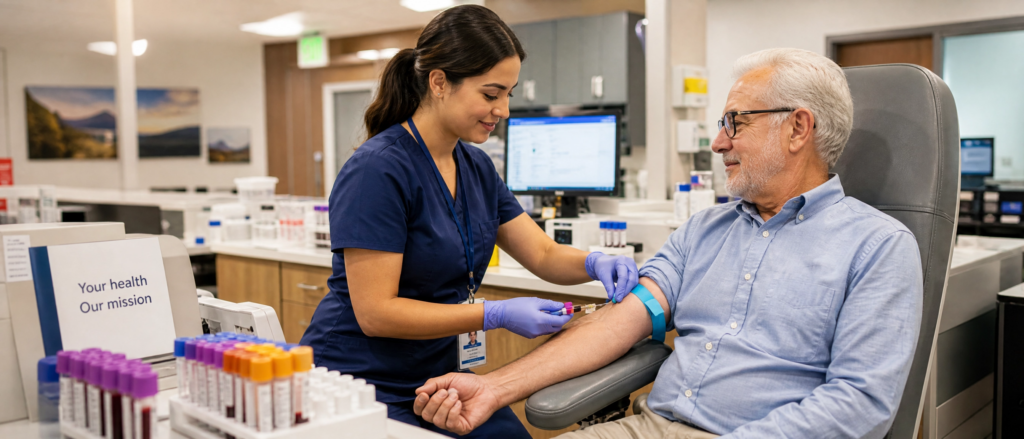
You cannot learn to draw blood just by reading a book. The second phase of your training is hands-on clinical practice. During this time, you will perform live blood draws under the supervision of an instructor.
To qualify for national certification, most agencies require you to complete a specific number of successful draws—typically 30 to 50 venipunctures and 10 capillary punctures. Depending on your clinical placement, this phase usually takes 1 to 3 weeks.
3. National Certification Exam (1 Day)
Once you complete your training, the final step is passing a national certification exam from a recognized agency like the NHA, AMCA, or NCCT. You can usually schedule this exam within a few weeks of finishing your program.
Fast-Tracking Your Career with Online Training
If you need to balance your training with a full-time job or family responsibilities, traditional classroom schedules can be a major roadblock. That is why online phlebotomy training has become the preferred route for many students.
With a reputable online program, you can complete the classroom portion of your training at your own pace. If you study aggressively, you can finish the coursework much faster than a traditional semester schedule allows. Once the theory is complete, you then move on to your hands-on clinical requirements.
State Requirements Can Affect Your Timeline
It is important to note that where you live can impact how long it takes to get to work. Four states—California, Washington, Nevada, and Louisiana—require state-issued licenses to practice phlebotomy. Getting a state license involves submitting your training records, passing a background check, and paying a fee, which can add a few weeks of processing time to your timeline.
For example, if you are looking at Phlebotomy Certification in California, you must factor in the time it takes the California Department of Public Health (CDPH) to process your application after you pass your national exam.
Is the Time Investment Worth It?
Absolutely. When you compare the time investment of phlebotomy to other healthcare careers, the return on investment is incredibly high. In just a few months, you can transition into a respected medical profession with strong job security, benefits, and a competitive salary.
According to the Bureau of Labor Statistics, the demand for phlebotomists is projected to grow much faster than average, and the average phlebotomist salary continues to rise as hospitals compete for certified talent [1].
Start Your Journey Today
If you are ready to start your career in healthcare, you do not have to wait years to make it happen. You can begin your training right now.
At Phlebotomy Career Training, our accredited programs are designed to get you certified and into the workforce efficiently. We provide the comprehensive curriculum, the clinical coordination, and the national exam preparation you need to succeed.
Enroll in our Online Phlebotomy Certification Program today and take the first step toward your new career.
References:
[1] Bureau of Labor Statistics, U.S. Department of Labor, Occupational Outlook Handbook, Phlebotomists. https://www.bls.gov/ooh/healthcare/phlebotomists.htm
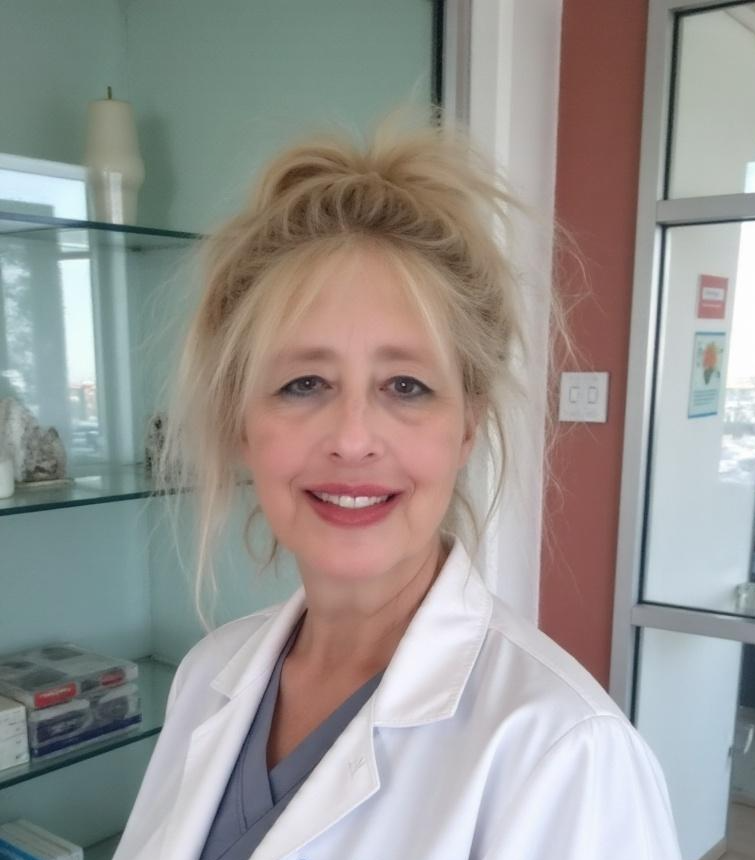
Nancy L. Kimmel obtained her PhD in Environmental Engineering in 2002, then went on to teach Physics and Mechanical Engineering at Lawrence Technological University, Henry Ford College and Oakland University. She obtained her Associate in Nursing from Henry Ford College and then went on to earn her Master Degree as a Family Nurse Practitioner and became Board Certified working as a licensed FNP in the State of Michigan. She then went on to Medical School where she is now in her 3rd year, and is also in the process of obtaining her Doctorate in Nursing Practice through Chamberlin University. She has authored the NET Study Guide, as well a several books on subjects of Math, ECG/EKG and Phlebotomy. She holds a patent on an Air Filter through the U.S. Patent Office.
313-826-2381