How to Prepare for Phlebotomy Training: 7 Tips for New Students
Starting a new healthcare career can be exciting, but it can also feel overwhelming when you are unsure what to expect. If you are preparing to enroll in phlebotomy training, you might be wondering whether you need medical knowledge beforehand, how to study effectively, or what skills you will need to develop.
The good news is that you do not need to know everything before your training begins. What matters is your willingness to learn, ask questions, follow safety procedures, and build your knowledge step by step.
Phlebotomy involves much more than collecting blood samples. It requires attention to detail, an understanding of patient safety, effective communication, and careful specimen handling. Each of these responsibilities contributes to the quality and reliability of laboratory testing.
With the right preparation, you can approach your training with a clearer understanding of what lies ahead.
Here are seven practical ways to prepare for phlebotomy training and make the most of your learning experience.
Preparing for phlebotomy training does not mean knowing everything before your first lesson. It means arriving ready to learn, practice, ask questions, and take responsibility for developing your skills.
Build a foundation in anatomy, establish consistent study habits, understand the importance of patient safety, and approach practical training with patience. Just as importantly, learn to communicate respectfully and recognize when you need guidance.
Every lesson is an opportunity to develop the knowledge and habits that support safe, accurate specimen collection.
If you are considering a career in phlebotomy, start by exploring your training options, comparing program requirements, and identifying the learning format that works for you.
Ready to take the next step? Explore phlebotomy training options at Phlebotomy Career Training and review the current program details to find a suitable starting point.
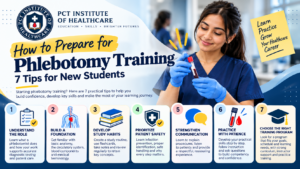
1. Understand What a Phlebotomist Actually Does
Before beginning your course, take some time to understand the responsibilities associated with phlebotomy.
Phlebotomists collect blood samples that healthcare professionals use for diagnostic testing, monitoring, research, and other medical purposes. Their work requires both technical knowledge and the ability to interact professionally with patients.
Depending on the workplace and the individual’s authorized responsibilities, common duties may include:
- Verifying patient identification and matching it with the laboratory order.
- Preparing the appropriate collection equipment.
- Explaining the procedure and helping patients feel informed.
- Following infection prevention and safety procedures.
- Collecting and labeling specimens accurately.
- Handling specimens according to established protocols.
- Communicating concerns and documenting information appropriately.
Accuracy matters throughout the process. An incorrectly identified or improperly handled specimen can affect laboratory results and subsequent clinical decisions.
Understanding these responsibilities before your course begins helps you recognize why each part of your training matters.
2. Build a Foundation in Basic Anatomy
You do not need to master anatomy before enrolling in phlebotomy training, but becoming familiar with a few foundational concepts can make the learning process easier.
Start by exploring the following subjects:
The circulatory system: Learn the basic functions of the heart, blood vessels, and blood.
Vein anatomy: Understand what veins are, their general location, and why vein selection is an important part of blood collection.
Blood components: Become familiar with red blood cells, white blood cells, platelets, and plasma.
Basic medical terminology: Learn common terms used in healthcare education, laboratory testing, and patient communication.
You can begin with introductory textbooks, diagrams, educational videos, or other credible learning resources.
Do not feel that you must memorize every anatomical term before your first class. Focus on understanding the fundamentals and use your course materials to build on that knowledge.
3. Develop Good Study Habits Early
Phlebotomy training includes information that builds from one topic to the next. Developing a consistent study routine can help you retain concepts and identify areas that need additional attention.
Instead of trying to learn everything in one sitting, divide your study sessions into manageable sections.
For example, you could organize your weekly learning around topics such as anatomy, infection prevention, specimen collection, equipment, patient communication, and specimen handling.
A few study techniques can make this process more effective:
- Create concise notes: Summarize key concepts in your own words.
- Use flashcards: Review terminology, equipment names, and important definitions.
- Practice retrieval: Close your notes and explain a concept from memory.
- Review regularly: Revisit previous lessons rather than studying each topic only once.
- Keep a question list: Write down concepts you do not understand and ask your instructor for clarification.
The objective is not simply to remember information for an examination. It is to develop an understanding you can apply when learning practical skills.
4. Make Patient Safety Part of Your Learning From Day One
Patient safety is central to phlebotomy practice. It should not be treated as a topic to review only before an examination.
During training, pay close attention to patient identification, hand hygiene, personal protective equipment, sharps safety, specimen labeling, and the prevention of contamination.
Understand why each procedure exists, not just the order in which the steps are performed.
For example, verifying a patient’s identity helps ensure that the specimen is associated with the correct person. Accurate labeling supports specimen traceability. Following infection prevention procedures helps reduce the risk of exposure and contamination.
You should also become familiar with the importance of reporting incidents, following workplace protocols, and seeking guidance when something is unclear.
A useful learning habit: Whenever you study a procedure, ask yourself three questions:
- What is the purpose of this step?
- What could go wrong if it is missed?
- What safety procedure or protocol applies?
These questions encourage you to think beyond memorization and understand the reasoning behind safe practice.
5. Strengthen Your Communication Skills
Phlebotomy is a patient-facing profession. Some patients may be comfortable with blood collection, while others may feel anxious, uncomfortable, or afraid of needles.
Your communication skills can help make the experience more respectful and reassuring.
Practice explaining information in clear, simple language. Learn to listen without interrupting, acknowledge concerns, and check whether a patient understands what you have explained.
Professional communication also includes respecting privacy, maintaining appropriate boundaries, and obtaining consent according to applicable procedures and policies.
For example, a patient might tell you that they have previously felt faint during a blood draw. That information should be taken seriously and handled according to the appropriate safety procedures and your role.
Being a good phlebotomist is not only about performing a technical task. It also involves recognizing that every specimen comes from a person who deserves respectful care.
6. Approach Practical Skills With Patience
One of the most important parts of phlebotomy training is learning how theoretical knowledge connects with practical performance.
You may study equipment, collection procedures, and safety principles before you feel comfortable applying them. That is a normal part of developing a new skill.
During practical training, focus on understanding the purpose of each step, listening carefully to instructor feedback, and following the approved procedure.
Remember that:
- Watching a demonstration is not the same as demonstrating competency.
- Completing an online lesson does not automatically establish practical proficiency.
- Repetition should be accompanied by appropriate instruction and feedback.
- Questions are an important part of learning.
- Clinical practice must follow applicable requirements and take place under appropriate supervision.
Do not rush through a skill simply because you have seen it performed before. Give yourself time to understand the process and demonstrate competency according to your program’s requirements.
Your instructor can help identify areas for improvement and clarify when you are ready to progress.
7. Choose a Training Program That Fits Your Learning Needs
Your preparation also includes choosing a program that aligns with your goals, schedule, and learning preferences.
Before enrolling, compare programs carefully instead of making your decision based only on course length or price.
Consider the following questions:
| What to evaluate | Questions to ask |
| Curriculum | Does the program cover anatomy, infection prevention, collection techniques, and specimen handling? |
| Learning format | Is the course online, in person, or hybrid? Will that format work for your schedule? |
| Instructor support | Can you ask questions and receive guidance when you need help? |
| Practical requirements | What supervised practice, clinical experience, or skills validation will be required? |
| Certification | Which credential or examination does the program prepare you for, and what are the eligibility requirements? |
| Total cost | What is included in the tuition, and are there additional fees or required supplies? |
| State requirements | Are there specific licensing, training, or clinical requirements where you intend to work? |
These questions can help you make an informed decision and understand what completing the program will involve.
Online learning can offer flexibility, but prospective students should confirm how practical skills, clinical requirements, and instructor support are handled before enrolling.
At PCT, prospective students can explore phlebotomy training and other healthcare education pathways through the school’s official website. Review the current course information and confirm the requirements that apply to your chosen program.
What Should You Expect During Phlebotomy Training?
Although course structures vary, phlebotomy education commonly introduces students to several interconnected areas of knowledge.
- Foundational knowledge: Anatomy, physiology, medical terminology, and the purpose of laboratory testing.
- Safety and infection prevention: Hand hygiene, protective equipment, sharps precautions, and appropriate handling of specimens.
- Collection procedures: Equipment preparation, patient identification, site selection, and the principles of venous and capillary blood collection.
- Specimen management: Labeling, handling, storage, transport, and factors that can affect specimen quality.
- Patient communication: Explaining procedures, responding professionally to concerns, respecting privacy, and following consent requirements.
- Assessment and practical development: Knowledge checks, examinations, supervised practice, or skills validation, depending on the program and applicable requirements.
The exact curriculum and clinical expectations will depend on the course you select. Review your program’s syllabus and ask your instructor which requirements you must complete.
Common Mistakes New Phlebotomy Students Should Avoid
Knowing what not to do can be just as useful as knowing how to prepare.
- Trying to memorize everything at once. Study consistently and build your understanding gradually.
- Ignoring the reasoning behind procedures. Understanding why a step matters helps you recognize its role in patient safety.
- Treating communication as an optional skill. Patient interaction is an important part of professional phlebotomy practice.
- Rushing through practical training. Follow the required procedure, accept feedback, and demonstrate competency before progressing.
- Assuming every certification has the same requirements. Eligibility, examinations, practical experience, and state rules can differ. Verify the requirements for your chosen credential and intended workplace.
- Being afraid to ask questions. If a procedure or concept is unclear, seek clarification rather than making assumptions.
Approaching your training with curiosity, patience, and a commitment to safe practice can help you build a stronger foundation.
Preparing for phlebotomy training does not mean knowing everything before your first lesson. It means arriving ready to learn, practice, ask questions, and take responsibility for developing your skills.
Build a foundation in anatomy, establish consistent study habits, understand the importance of patient safety, and approach practical training with patience. Just as importantly, learn to communicate respectfully and recognize when you need guidance.
Every lesson is an opportunity to develop the knowledge and habits that support safe, accurate specimen collection.
If you are considering a career in phlebotomy, start by exploring your training options, comparing program requirements, and identifying the learning format that works for you.
Ready to take the next step? Explore phlebotomy training options at Phlebotomy Career Training and review the current program details to find a suitable starting point.
Frequently Asked Questions
1. Do I need medical experience before starting phlebotomy training?
Not necessarily. Entry requirements vary by program, so check the specific course prerequisites before enrolling. Some programs are designed for beginners, while others may require prior healthcare experience.
2. What should I study before my first phlebotomy class?
Start with basic anatomy, the circulatory system, blood components, medical terminology, and general infection prevention concepts. You can then build on these foundations through your formal training.
3. Is phlebotomy training only about learning to draw blood?
No. Training also covers patient identification, communication, infection prevention, specimen handling, documentation, and other responsibilities associated with safe and accurate blood collection.
4. Can I complete phlebotomy training online?
Some programs offer online coursework, but the practical and clinical requirements vary. Confirm whether your chosen program requires supervised blood draws, clinical experience, skills assessments, or other in-person components.
5. Does completing a training course automatically make me eligible for certification?
Not always. Eligibility depends on the certification organization and its requirements, which may include education, examinations, documented practical experience, or other criteria. Confirm eligibility directly with the relevant credentialing body.
6. How can I prepare for the phlebotomy certification examination?
Follow your program’s study plan, review the examination content outline, use credible study materials, practice answering questions, and revisit topics you find difficult. Make sure you understand the applicable examination and eligibility requirements before scheduling your test.
7. What qualities are useful for a phlebotomist?
Attention to detail, patience, clear communication, professionalism, respect for patient privacy, and a commitment to safety are all valuable qualities. Technical skills must also be developed and assessed through appropriate training.
